SNC-Logo
Conservation
Legislation

Please check back soon for details regarding State Wildlife Grant bills.

To find contact information for your legislators please check out the following links:

Partners in Flight

The Nevada Partners in Flight Bird Conservation Plan (Neel 1999) was completed by the NVPIF working group (Larry Neel, editor) in 1999. Since then, it has been the working group's goal to implement a coordinated, statewide, comprehensive, long-term monitoring program that meets all of the objectives outlined in the BCP (Neel 1999). Existing monitoring programs contribute to this effort, but the focus of the program is to develop a statewide network of point count transects that will provide coverage throughout all of the physiographic regions and habitat types covered by the BCP, and generate status and trend information for all bird species breeding in Nevada.

The Great Basin Bird Observatory is taking the lead role in implementing and coordinating the statewide point count network. The Lahontan Audubon Society was instrumental in developing the conceptual framework of the All Bird Monitoring Program and facilitating the project's development and implementation by commissioning a Concept Paper. Aside from the statewide point count network, additional monitoring efforts were proposed to cover priority species including Flammulated Owl and secretive, dispersed, and threatened and endangered species such as Long-billed Curlew and Yellow-billed Cuckoo. One such study of Flammulated Owls in the Spring Mountains was completed in 2002 by LAS's field trip chairperson at the time. This study was facilitated by GBBO and funded by USFS Humboldt-Toiyabe National Forest.

Members of both the Lahontan and Red Rock Audubon chapters are active volunteers for All Bird Monitoring efforts. Contact GBBO to see how you can help with the statewide point count network.

Return to top of page
Project FeederWatch

Bird watchers in Nevada are contributing their observations to a long-term database of birds that visit feeders in winter. These people, who document birds in areas ranging from Las Vegas to Reno and areas in between (including Baker, Winnemuca, and Elko), take part in a North American winter bird monitoring program called Project FeederWatch.

Project FeederWatch is a volunteer-based survey of birds organized by the Cornell Lab of Ornithology and the National Audubon Society. The project was begun in 1987, and generates data for scientific research of winter bird populations. Their latest research was just published in the Proceedings of the National Academy of Sciences, a highly regarded scientific journal.

Last winter, Nevada "FeederWatchers" observed a total of 46 species of birds. Birds that commonly visited Nevada feeders include the House Finch, White-crowned Sparrow, California Quail, American Goldfinch, and Pine Siskin. On average, Nevada FeederWatchers contributed data for 13 species of birds per feeder, though one FeederWatcher reported seeing 28 species last winter.

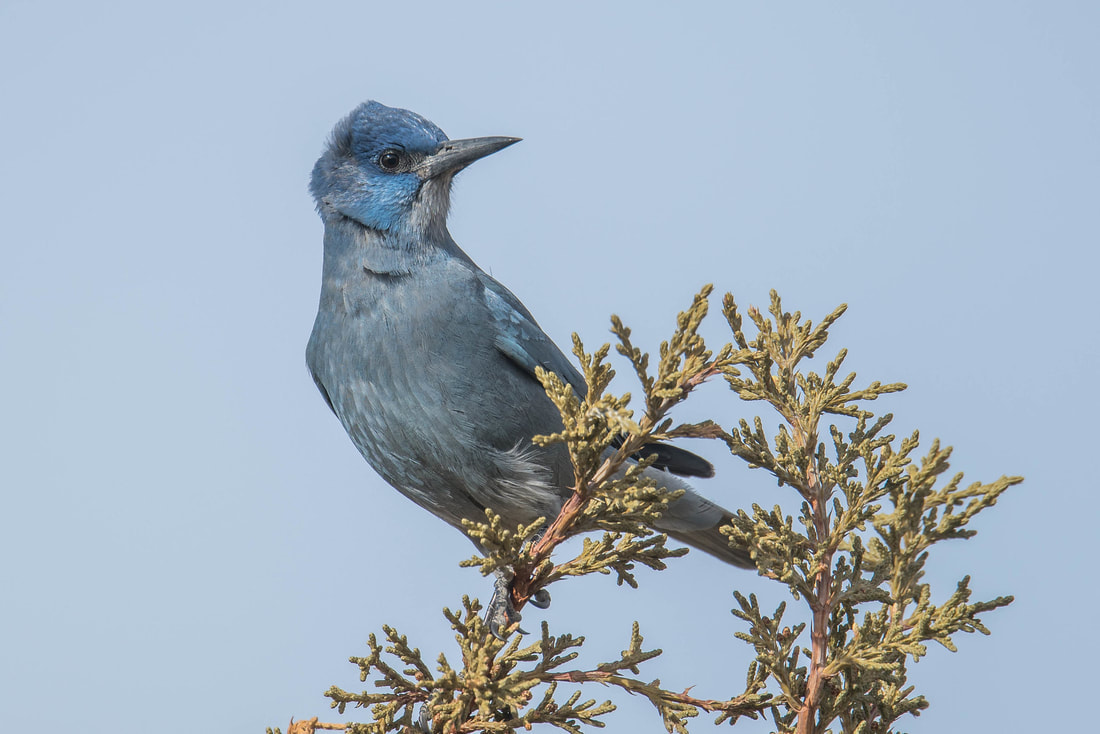
Birds that appeared at feeders in the largest numbers include the Pinyon Jay (an average of 38 birds per feeder), the House Sparrow (29 birds) and the California Quail (25 birds). Many "loner" species were also reported, including predatory birds such as the American Kestrel (1 bird) and the Sharp-shinned Hawk (1bird) .

Some FeederWatchers in Nevada reported Great-tailed Grackle, a species that has steadily expanded into the Southwest since the 1970s. The grackle prefers the newly developed second-growth and agricultural habitats of the Southwest, and has readily advanced up major river valleys, jumping from river to river as they forge northward.

"To get a complete picture of what is happening with feeder birds over their entire winter ranges, we need more data from certain regions, especially in Nevada where there is such diversity of habitats and birds" says Laura Kammermeier, the project's leader. For example, a single FeederWatcher in the low desert of southern Nevada ensured that Abert's Towhee was represented, while another watcher from the forested mountains of northern Nevada provided the state's only record of Pine Grosbeak last year. "We need more people in more areas to ensure that all winter feeder birds are fairly represented by our database."

This past winter, the project received observations from only 17 FeederWatchers in Nevada (37 registered for the project). Because of this, Kammermeier and her colleagues at the Lab of Ornithology are making a special plea to Audubon members in Nevada to join their survey.

Bird watchers of all skill levels are invited to participate. If you feed birds and would like to contribute to the long-term record of feeder birds, call (800) 843-2473. A Research Kit and quarterly newsletter help you maintain a safe and productive feeder area and keep you informed of latest trends. FeederWatch is primarily funded by its participants, and a $15 participation fee defrays the cost of materials. For more information and to get involved in Project FeederWatch, visit the Cornell Lab of Ornithology Project Feeder Watch Page.

Return to top of page

Carson Lake and Pasture

Background

Carson Lake and Pasture are located in the south-eastern portion of the Lahontan Valley in Churchill County, approximately six miles south of the town of Fallon. The area is on approximately 22,000 acres of withdrawn public lands, currently administered by the Bureau of Reclamation (BOR).

Prior to settlement of the Valley, Carson Lake was part of the terminus of the Carson River during significant periods of time. When settlers began to farm in the Valley, the total flow of the River was to Carson Lake. During these early years, as the lake reached capacity, it overflowed and discharged through the Stillwater Slough to the Stillwater Marsh at what is now the Canvasback Gun Club.

With the development of the Newlands Irrigation Project, flow patterns and quantities of water to Carson Lake began to be significantly altered. The main river was redirected to the Carson Sink as development of the Project proceeded and inflows into Carson Lake shifted from prime water inflows to greater percentages of irrigation return flows. In the period from 1972 to 1990, return flows averaged 62,000 Acre Feet of water annually.

Since 1912, the Greenhead Hunting Club has been a dominant factor in the perpetuation of the wetlands within the Carson Lake and Pasture area.

As a part of the Newlands Irrigation Project, the Carson Lake and Pasture area was turned over to the Truckee-Carson Irrigation District (TCID) for management as a pasture for use by local irrigators to graze their livestock. In 1980, at the advice of the Carson Lake Advisory Board and through funding mostly by the Greenhead Hunting Club, an 11 mile fence was constructed to exclude livestock from the main wetland portion, encompassing approximately 7,500 acres.

In recent years, since 1979, management recommendations for the Carson Lake and Pasture area have come through the Carson Lake Advisory Board.

Carson Lake is recognized as a significant wetland area through its inclusion into the Western Hemisphere Shorebird Reserve Network. Carson Lake provides habitat for migrants including over 150,000 ducks, 2.000 Canada geese, 30,000 Snow geese and 130,000 Shore birds. In addition, it is a significant production area for white-faced ibis, black-necked stilts, American avocets, snowy and great egrets, redheads, gadwalls and cinnamon teal. Carson Lake is host to one of the largest white-faced ibis nesting colonies in the western United States, averaging 3,000 pairs over the long term.

In 1990, Congress passed Public Law 101-618 in which Section 206(e) authorizes the Secretary of the Interior to transfer title of the 22,700 acres comprising the Carson lake and Pasture area to the State of Nevada to be managed by the Nevada Division of Wildlife (NDOW) as a Wildlife Management Area.

Current Status

Requirements for the transfer of Carson Lake and Pasture area included the preparation of an Environmental Assessment, resolving legal responsibility for hazardous materials (mainly mercury) that exists in the area, and the Agreement for the Transfer and Management of Carson Lake and Pasture. Lahontan Audubon prepared the Environmental Assessment for the transfer. We understand that the State of Nevada and Interior have agreed on the legal responsibility for the mercury problem and Nevada's Governor, Kenny C. Guinn signed the Transfer and management agreement in 1999.

The State of Nevada, as authorized in Public Law 101-618, has been purchasing water rights within the Carson Division of the Newlands Project for Carson Lake. Funds for these purchases were authorized in a bond passed by the Nevada voters.

The transfer of Carson Lake and Pasture area to the State of Nevada is being held up at the request of the Pyramid lake Piaute Tribe until other water related issues involving the use of Truckee and Carson River waters are resolved to their satisfaction.

Lahontan Audubon Society Position

The transfer of the Carson Lake and Pasture to the State of Nevada as authorized by Public Law 101-618 is independent of the water related issues involving the use of Truckee and Carson River waters. These water issues will most likely be resolved in court. In 1999, Nevada Governor and Lahontan Audubon sent letters to the Secretary of the Interior requesting that the provisions of Public Law 101-618, as it relates to the Carson Lake and Pasture area be carried out and the transfer to the State of Nevada be consummated.

Lahontan Audubon has previously supported the transfer of the Carson Lake and Pasture area and has joined with the Lahontan Wetlands Coalition in also supporting the transfer and management of the area. Specific actions that can be taken by Lahontan Audubon include:

  • Support title transfer of the Carson Lake and Pasture area to the State of Nevada for management by the Nevada Division of Wildlife (NDOW) as a Wildlife Management Area by again encouraging the Secretary of the Interior to approve the title transfer without further delay.
  • Request that National Audubon send a similar letter to the Secretary.
  • Work with NDOW and the other members of the Wetlands Coalition in the development, review and implementation of the Carson Lake and Pasture Management Plan.
  • Request that Lahontan Audubon be designated as a member of the Carson Lake Advisory Board (CLAB).
  • Work with NDOW, U.S. Fish and Wildlife Service (Stillwater Refuge), and the other members of the Wetlands Coalition and the Friends of Stillwater in the development, review and implementation of a basic management plan for the Lahontan Valley Wetlands, which would guide water management and management coordination of all wetlands in the Valley.

Respectively Submitted: February 8, 2001
Ed Tilzey
LAS Conservation Chairman

Return to top of page
Walker Lake/Walker River

Background

Over the past century, upstream water use and decreasing water supplies have left the Walker River and Walker Lake lacking of water flows. The Walker River is the primary water source for Walker Lake. Streamflow in the Walker River has averaged 327,000 acre-feet per year for 55 years (1939 to 1993). From 1882 to 1994, the surface level of Walker Lake has declined some 136 feet, but more significantly, the dissolved-solids concentration in Walker Lake increased from 2,500 milligrams per liter to 13,300 milligrams per liter (mg/L). This approaches a near lethal level for aquatic organisms, including fish.

The U.S. Geological Survey, in a 1994 study, estimates that to maintain the dissolved-solids concentration at the current (July 1994) level of 13,300 mg/L, about 33,000 acre-ft./yr. more water than the long term average is needed. To reduce the 1994 dissolved-solids concentration to 10,000 mg/L, the lake-surface altitude would need to be raised approximately 20 ft.-to 3,964 ft.- which is equivalent to about 700,000 acre-ft. of water. Then, to maintain this lake level, an additional 47,000 acre-ft/yr. more water than the long-term average would be needed (based on the 1939-93 hydrologic conditions).

Walker Lake is a significant habitat for the tui chub and Lahontan Cutthroat trout and provides habitat for up to 1400 migrating loons and other fish-eating birds. The Walker River also provides considerable riparian and wetland habitat for birds. Some of the existing habitat has been created since the advent of modern agriculture, while other habitats have been degraded during that time.

Current Status

The Bureau of Land Management (BLM) is preparing an Environmental Impact Statement (EIS) to analyze a series of proposed actions for the Walker Lake and Walker River basin. These proposed actions (and alternatives) include:

  • Acquire additional water (water rights) for maintenance of the current level of Walker Lake.
  • Acquire additional water (water rights) to raise Walker Lake to a higher level and to then maintain the lake at that level.
  • Acquire additional water rights for agricultural purposes for the various Indian tribes within the Walker River basin. (There is also an ongoing federal lawsuit to acquire additional water rights for these various Indian tribes.)
  • Restore the Lahontan Cutthroat trout in Walker Lake.
  • Restore the habitat for the Lahontan Cutthroat trout on the Walker River and its tributaries.
  • Restore the Lahontan Cutthroat trout in the Walker River and its tributaries.

In 1994, it was estimated that with no inflow to Walker Lake within two to four and one-half years, Walker Lake's fisheries would no longer be viable and the tui chub would cease to reproduce. This would result in the loss of the major food source for the Lahontan Cutthroat trout and the migrating loons and other fish-eating birds. Since that time, significant additional waters have reached the lake as a result of higher annual precipitation within the basin. Even with these additional waters resulting in a higher water elevation of the lake and lower dissolved-solids concentration, there is a need for some level of action that will assure a sustainable lake level with acceptable concentrations of dissolved-solids.

Lahontan Audubon Society Position

The Lahontan Audubon Society's position on the current proposals for Walker Lake and the Walker River including its tributaries is based on the habitat needs for resident and migrating birds, It will need to be updated as the federal position is refined and includes the following:

  • Assure a sustainable level of Walker Lake with acceptable concentrations of dissolved-solids to perpetuate a viable population of Tui chub, thus maintaining a necessary food source for migrating loons and other fish-eating birds.
  • Habitat changes proposed along the Walker River should be beneficial to birds inhabiting such wetland and riparian zones.
  • In preparing the Walker River Basin EIS, the agencies involved should utilize the recently prepared Nevada Bird Conservation Plan.
  • The involved federal agencies should analyze and mitigate the impacts resulting from the removal of irrigation water when farm land is acquired. These impacts may include the loss of riparian, wetlands, trees and other habitat for birds and other wildlife.
  • The Department of the Interior (DOI) must be careful that in resolving fisheries impacts created throughout the past century that they do not create a new set of adverse impacts to the various species of birds which inhabit the Walker Lake/River Basin.

Respectively Submitted;
12/5/2000
Ed Tilzey
LAS Conservation Chairman

Return to top of page
NDOW Predator Management Plan

LAS statement on Nevada Department of Wildlife's Nevada Predator Management Plan

February 4, 2004

After reviewing the Department of Wildlife's Nevada Predator Management Plan Fiscal Year 2004, the Lahontan Audubon Society wishes to express several concerns. Since our organization's focus is on avian species, we have limited our comments specific to the current raven control projects. Lahontan Audubon Society respectfully requests the Commission terminate projects 1 and 5, Raven Control to Enhance Sage-Grouse Nesting Success and Protection of Upland Game Birds and Waterfowl - Moapa Valley. Additionally, for reasons stated below, it is our hope that the Commission will reevaluate its approval of any projects that focus on removal of Common Ravens.

Despite an implied objective to remain science-based and goal oriented, the Predator Management Plan Fiscal Year 2004 does not provide sound evidence of an over abundance of predators in Nevada that might warrant such control measures. Additionally, the plan fails to demonstrate that removal of ravens will have a positive effect on recruitment of Greater Sage-Grouse or other ground nesting birds. The plan lacks baseline data on predator abundance or predator/prey interactions between ravens and ground-nesting birds within either of the project areas. In the absence of baseline data, there is no mechanism for post treatment comparison. The plan is void of any references that validate predator removal as an efficient, cost effective management option that has been successfully used in other areas. Additionally, the plan neglects to clearly define goals and objectives for each project. There is inadequate information provided in this plan to warrant approval of these projects by the Commission. If this plan is a project 'update' to the Commission, as opposed to an actual plan, we suggest a plan be written that addresses the aforementioned deficiencies.

The majority of published research clearly demonstrates predator removal does not produce intended results of increasing recruitment of ground nesting birds (Goransson and Loman 1982, Parker 1984, and Parr 1993). Clark et al. (1995) found removing American crows to improve duck nesting success did not result in a difference in estimated nesting success between control and removal plots. Clark also found that nest success was not inversely related to crow abundance, indicating that more crows did not mean lower nest success. Parr (1993), although unable to show an increase in nest success of Golden Plovers after removal of crows and gulls, did show greater hatching success of other waders. However, despite the increased hatching success in the absence of crows and gulls, predator removal did not lead to a significant increase in numbers for any species.

The complexity of predator/prey relationships cannot be underestimated. Removal of predators has far reaching consequences. Often, predator removal has indirect negative effects on prey populations as a result of increasing populations of predators at other trophic levels, ultimately resulting in lower biodiversity. In order to accurately assess the effectiveness of removing one predator species, any post-treatment analysis must take into consideration affects of other predators.

Low recruitment of ground-nesting birds is believed to be largely a result of habitat degradation and fragmentation. By focusing on improving habitat we affect change resulting in positive improvements for a number of species. In a review of biological options and concepts to reduce predation on ground-nesting birds, Clark et al. (1996) noted advantages of habitat restoration compared to predator management involving removal or chemical controls to be 1) low maintenance; (2) income to landowners; (3) benefits to a wide range of species in addition to game birds; and (4) conservation of soil and water resources. They believe these benefits should be incorporated into cost-benefit analyses of management alternatives, including predator removal. They conclude by stating, "Implementation of predator control (e.g., chemical, removal) likely will be site-specific, small-scale and have only limited spin-off benefits. In sharp contrast, benefits of vegetation management may be manifold."

Clark et al. (1995) assert habitat manipulations alone might reduce predation of duck eggs by crows or other aerial predators that rely on visual cues to locate nests. They are not alone as Sugden and Beyersbergen (1987) and Sullivan and Dinsmore (1990) conclude establishing robust stands of natural vegetation to provide well-concealed nest sites may help reduce nest predation by crows. Gregg et al. (1994) found a relationship between vegetational cover and predation of Greater Sage-Grouse nests. Their data showed specifically, non-predated nests had greater cover of tall, residual grasses and medium height shrubs than predated nests. Due to this relationship, DeLong et al. (1995), based on similar results as Gregg et al (1994), suggest that land management practices that reduce herbaceous cover in sagebrush communities can negatively affect Greater Sage-Grouse nesting habitat.

The report compiled by the Nevada Department of Wildlife in 1990 as a result of Federal Aid funding titled 'Sage-Grouse Production and Mortality Studies' is the study used, in part, as support for Project 1 (Woolstenhulme, pers. comm. 2003). The studies regarding nest predation conducted in Idaho (Autenrieth 1981, in Klebenow et al. 1990) and in Elko County clearly indicate habitat as being a factor in nest success. The comparison of nest losses under differing habitat conditions in Washoe County and Elko County reveals less nest predation on the Saval Ranch (Elko Co.), where there is significantly more live canopy cover and ground cover. And, the report states in the conclusion, "On the Grassy Meadows/Hart Camp areas, near the edge of the sage-grouse distribution, predation may be having a significant impact on sage-grouse production. This may be related to poorer nesting cover found on these western Nevada areas compared to northeastern Nevada in Elko County."

Ground nesting birds such as Greater Sage-Grouse have evolved with predators and their decline over the years has not solely been a result of predation. Predation remains only one of a great number of variables that affect Greater Sage-Grouse populations. It is written in the Sage-Grouse Conservation Strategy, "The effects of predation on population dynamics cannot be clearly understood until habitat quality is at "optimum," at which time the interaction between habitat quality and predation is minimized. Under optimal habitat conditions, nest success and juvenile survival should exceed the level needed to just maintain a stable population and population increases would be anticipated."

Predator management has been used for generations and for a variety of reasons; threats to human life, protection of livestock resources, protecting and enhancing sport recreation opportunities, as well as protection of endangered species. Lahontan Audubon Society recognizes the imbalance of natural systems that currently exists. We acknowledge predator control as one of many tools available to wildlife managers. At a time when many species are at risk of extinction we would be remiss if we did not consider all management options available. Predator control has been used successfully in protection of species at risk or those already listed as endangered, such as the Snowy Plover, desert tortoise, and White River spinedace, to name a few. However, these projects are specific in nature, are supported by sound data and are implemented as a result of increasing threats and rapidly declining numbers. Predator control is a stopgap measure that serves to buy time, while other threats to populations are addressed. While recognizing the utility in predator control, we find that adequate data are not provided that reflects an urgency to warrant the proposed raven control projects.

Legislation AB 291, passed in 2001, gives the Commission considerable flexibility in the expenditure of funds. Spending options include costs related to research, habitat projects, and education. We believe that the money currently being used to eliminate ravens would be more effectively spent on projects designed to improve habitat. Projects should also be designed to inform the public of the importance of habitat in creating stable populations able to withstand normal rates of predation.

Several well-respected national sportsmen's organizations such as Ducks Unlimited (DU), The Ruffed Grouse Society, National Wild Turkey Federation, and Pheasants Forever focus their efforts, and sportsmen's dollars on habitat improvements to elicit long-term benefits to ground-nesting birds. DU informs their constituents by providing information on their website in the form of questions and answers regarding predator control. Although the organization may at times use predator control on a very small scale, it recognizes it as an ineffective method of long-term waterfowl conservation. The National Wild Turkey Federation believes the best way to combat predation is through the building of healthy wild turkey populations. Money raised by sportsmen in Nevada for this organization goes towards introductions, habitat improvement projects, education, equipment, and other support for the various agencies involved (Johnson, pers. com. 2004).

There is consensus across all conservation groups that working together towards establishing healthy populations of the state's wildlife resources should remain our top priority. The Commission has the ability to promote positive change in how the state manages wildlife resources. We hope that you find our concern for this issue warranted and our comments constructive in nature.

In closing we recommend the following:

  • Obtain baseline data that can be used to design appropriate, scientifically sound projects with testable hypotheses, adequate replications and controls to assure statistically defensible results, and clearly defined goals and objectives.
  • Work cooperatively with land managers, attempting to resolve the underlying primary cause (habitat degradation) for species decline, resulting in positive long-term benefits for multiple species.
  • Forego projects focusing on work associated with a proximal cause (predation) that does not provide for long-term viability of species.
  • Consider projects that represent a wide variety of management options.

Respectfully submitted,
Ray Nelson
President
Board of Trustees
Lahontan Audubon Society

Literature Cited:

Clark, R.G., K.L. Guyn, R.C.N. Penner, and B. Semel. 1996. Altering predator foraging behavior to reduce predation of ground-nesting birds. Transactions of the North American Wildlife and Natural Resources Conference. 61: 118-126.
Clark, R.G., D.E. Meger, and J.B. Ignatiuk. 1995. Removing American Crows and duck nesting success. Can. J. Zool. 73: 518-522.
DeLong, A.K., J.A. Crawford, and D.C. DeLong, Jr. 1995. Relationships between vegetational structure and predation of artificial Sage-Grouse nests. J. Wildl. Manage. 59(1): 88-92.
Goransson, G., and J. Loman. 1982. Does removal of breeding crows increase pheasant production --an experiment. In Transactions of the 14th International Congress of Game Biolgists. pp. 331-334.
Governor Guinn's Sage Grouse Conservation Planning Team. 2001. Nevada Sage-Grouse Conservation Stategy (Neel, L. ed.). 73pp.
Gregg, M.A., J.A. Crawford, M.S. Drut, and A.K. DeLong. 1994. Vegetational cover and predation of Sage-Grouse nests in Oregon. J. Wildl. Manage. 58(1): 162-166.
Johnson, B. 2004. Regional Field Supervisor, National Wild Turkey Federation. Personal communication, 01/02/04.
Klebenow, D., G. Zunino, M. Stigar, and A. Altstatt. 1990. Sage Grouse production and mortality studies. (Stiver, S. ed.). Fed. Aid Wildl. Res. Proj. W-48-R-21, Study XVII, Job 1, Nevada Department of Wildlife. 23pp.
Parker, H. 1984. Effect of corvid removal on reproduction of Willow Ptarmigan and Black Grouse. J. Wildl. Manage. 48(4): 1197-1205.
Parr, R. 1993. Nest Predation and Numbers of Golden Plovers Pluvialis apricaria and other Moorland waders. Bird Study. 40: 223-231.
Sudgen, L.G. and G.W. Beyersbergen. 1987. Effect of nesting cover density on American crow predation for simulated duck nests. J. Wildl. Manage. 51: 481-485.
Sullivan, B.D., and J.J. Dinsmore. 1990. Factors affecting egg predation by American crows. J. Wildl. Manage. 54: 433-437.
Woolstenhulme, R. 2003. Nevada Predator Management Plan. Nevada Department of Wildlife, Reno, Nevada. 48 pp.